• Blog
  • Docs
  • Careers
  • Get Support
  • Contact Sales
DigitalOcean
  • Featured AI Products

    Compute

    Build, deploy, and scale cloud compute resources

    Containers and Images

    Safely store and manage containers and backups

    Managed Databases

    Fully managed resources running popular database engines

    Management and Dev Tools

    Control infrastructure and gather insights

    Networking

    Secure and control traffic to apps

    Security

    Help protect your account and resources with these security features

    Storage

    Store and access any amount of data reliably in the cloud

    Browse all products

  • AI/ML

    CMS

    Data and IoT

    Developer Tools

    Gaming and Media

    Hosting

    Security and Networking

    Startups and SMBs

    Web and App Platforms

    See all solutions

  • Community

    Documentation

    Developer Tools

    Get Involved

    Utilities and Help

  • Become a Partner

    Marketplace

  • Pricing
  • Log in
  • Sign up
  • Log in
  • Sign up

Company

  • About
  • Leadership
  • Blog
  • Careers
  • Customers
  • Partners
  • Referral Program
  • Affiliate Program
  • Press
  • Legal
  • Privacy Policy
  • Security
  • Investor Relations

Products

  • GPU Droplets
  • Bare Metal GPUs
  • Inference Engine
  • Data & Learning
  • Evaluations
  • Model Library
  • Droplets
  • Kubernetes
  • Functions
  • App Platform
  • Load Balancers
  • Managed Databases
  • Spaces
  • Block Storage
  • Network File Storage
  • API
  • Uptime
  • Cloud Security Posture Management (CSPM)
  • Identity and Access Management (IAM)
  • Cloudways
  • View all Products

Resources

  • Community Tutorials
  • Community Q&A
  • CSS-Tricks
  • Write for DOnations
  • Currents Research
  • DigitalOcean Startups
  • Wavemakers Program
  • Compass Council
  • Open Source
  • Newsletter Signup
  • Marketplace
  • Pricing
  • Pricing Calculator
  • Documentation
  • Release Notes
  • Code of Conduct
  • Shop Swag

Solutions

  • AI Training GPU
  • GPU Inference
  • VPS Hosting
  • Website Hosting
  • VPN
  • Docker Hosting
  • Node.js Hosting
  • Web Mobile Apps
  • WordPress Hosting
  • Virtual Machines
  • View all Solutions

Contact

  • Support
  • Sales
  • Report Abuse
  • System Status
  • Share your ideas

Company

  • About
  • Leadership
  • Blog
  • Careers
  • Customers
  • Partners
  • Referral Program
  • Affiliate Program
  • Press
  • Legal
  • Privacy Policy
  • Security
  • Investor Relations

Products

  • GPU Droplets
  • Bare Metal GPUs
  • Inference Engine
  • Data & Learning
  • Evaluations
  • Model Library
  • Droplets
  • Kubernetes
  • Functions
  • App Platform
  • Load Balancers
  • Managed Databases
  • Spaces
  • Block Storage
  • Network File Storage
  • API
  • Uptime
  • Cloud Security Posture Management (CSPM)
  • Identity and Access Management (IAM)
  • Cloudways
  • View all Products

Resources

  • Community Tutorials
  • Community Q&A
  • CSS-Tricks
  • Write for DOnations
  • Currents Research
  • DigitalOcean Startups
  • Wavemakers Program
  • Compass Council
  • Open Source
  • Newsletter Signup
  • Marketplace
  • Pricing
  • Pricing Calculator
  • Documentation
  • Release Notes
  • Code of Conduct
  • Shop Swag

Solutions

  • AI Training GPU
  • GPU Inference
  • VPS Hosting
  • Website Hosting
  • VPN
  • Docker Hosting
  • Node.js Hosting
  • Web Mobile Apps
  • WordPress Hosting
  • Virtual Machines
  • View all Solutions

Contact

  • Support
  • Sales
  • Report Abuse
  • System Status
  • Share your ideas
© 2026 DigitalOcean, LLC.Sitemap.
Product updates

Block Storage Volumes Gets a Performance Burst

author

By Priya Chakravarthi

  • Published: May 15, 2018
  • 3 min read
<- Back to blog home

At DigitalOcean, we’ve been rapidly adding new products and features on our mission to simplify cloud computing, and today we’re happy to announce our latest enhancement.

Over the first half of 2018, we’ve improved performance for Block Storage Volumes with backend upgrades that reduce cluster latency by 50% and provide new burst support for higher performance for spiky workloads.

Burst Performance Characteristics

Block Storage Volumes have a wide variety of use cases, like database reads and writes as well as storing logs, static assets, backups, and more. The performance expectations from a particular volume will depend on how it’s used.

Database workloads, for example, need single-digit millisecond latency. Most workloads in the cloud today are bursty, however, and don’t require sustained high performance at all times. Use cases like web servers, backups, and data warehousing can require higher performance due to short increases in traffic or a temporary need for more bandwidth.

To meet the need for very low latency, we upgraded Ceph to its latest version, Luminous v12.2.2, in all regions containing Block Storage. This reduced our cluster latency by 50% and provides the infrastructure you need to manage databases with Block Storage Volumes.

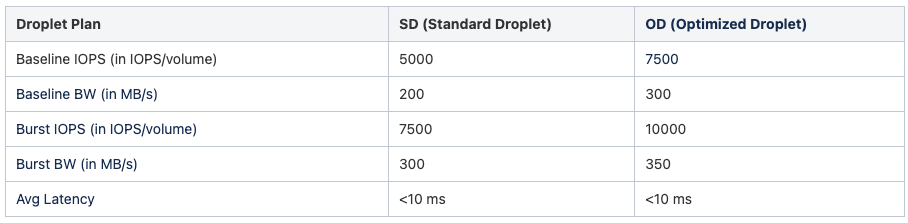
To support spiky workloads, we added burst support, which automatically increases Block Storage Volumes’ IOPS and bandwidth rates for short periods of time (60 seconds) before returning to baseline performance to cool off (60 seconds).

Here’s a summary of the burst performance characteristics, which compares a Standard Droplet (SD) plan and an Optimized Droplet (OD) plan:
Block storage performance

We don’t scale performance by the size of the volume you create, so every Block Storage Volume is configured to provide the same level of performance for your applications. However, your application needs to be written to realize these limits, and the kind of performance you get will depend on your app’s configuration and a number of other parameters.

Performance and Latency Benchmarking

To learn more about the performance you’re getting, we wrote How To Benchmark DigitalOcean Volumes, which explains not only how to benchmark your volumes but also how to interpret the results.

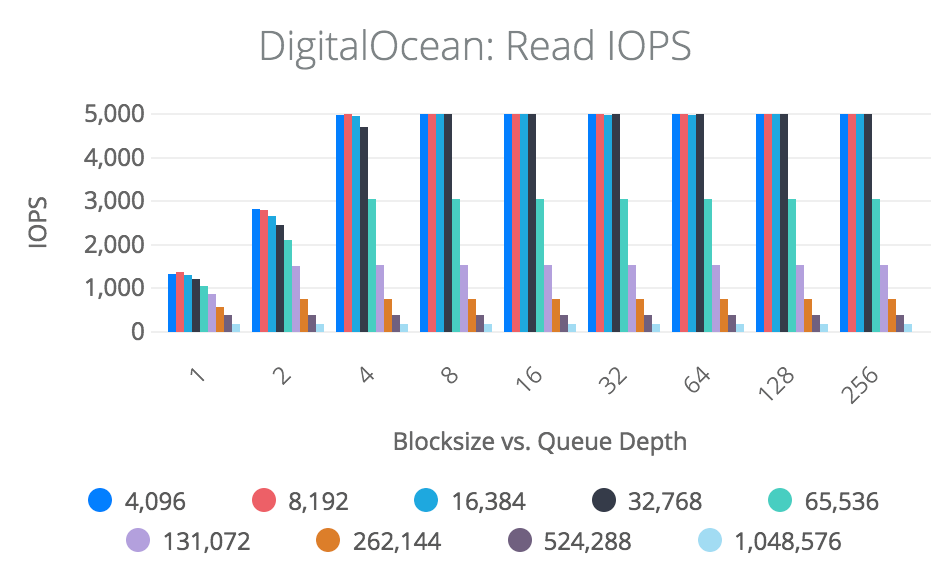
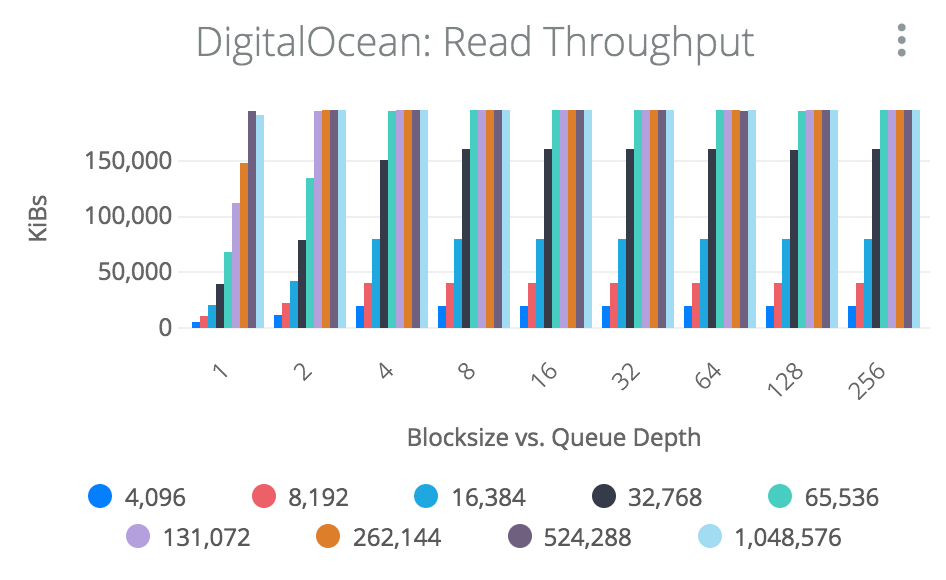
We then ran some of these tests internally to share the numbers and performance of our offering. You can find all the details in the tutorial, but here’s a sample of results, which shows typical performance based on the queue depth (QD) of the application and the block size (on the x-axis) versus IOPS (on the y-axis).
Read IOPS graph

Read Throughput graph

These graphs show that the IOPS rate increases as queue depth increases until we hit our practical IOPS cap. Smaller block sizes tend to be IOPS limited, while larger block sizes tend to be bandwidth limited.

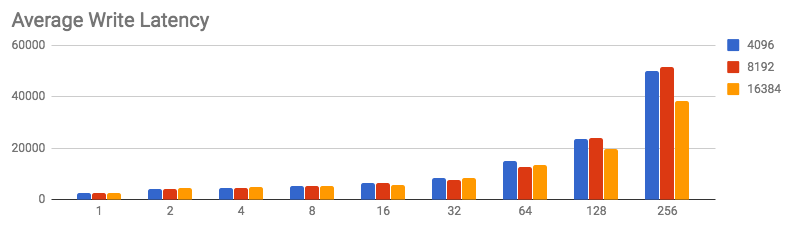
What about latency? Most real-world customer applications won’t run the same kind of workload often used as a baseline (QD = 1 4K I/O), so these graphs show latency in µsec (or microseconds) as we add load to the cluster.
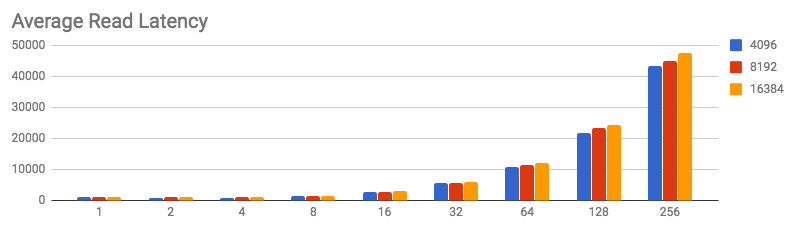
Average read latency

Average write latency

We see the same behavior in reads and writes. Because of how the backend storage stores the data, our results show that 16K has better latency at high queue depth, so we recommend you tune for 16K workloads if possible.

What’s Next?

The performance improvements aren’t the only thing we have in store. There are several QoS features and infrastructure investments in the pipeline to improve your experience of Block Storage Volumes. (Ready to get started? Create a Volume now.)

We’d love to hear your thoughts, questions, and feedback. Feel free to leave a comment here or reach out to us through our UserVoice.

About the author

Priya Chakravarthi
Priya Chakravarthi
Author

Share

  • Product Updates

Start building today

From GPU-powered inference and Kubernetes to managed databases and storage, get everything you need to build, scale, and deploy intelligent applications.
Sign up

Related Articles

DigitalOcean Evaluations: Production Model and Router Testing for the Inference Stack
Product updates

DigitalOcean Evaluations: Production Model and Router Testing for the Inference Stack

Grace Morgan
  • July 1, 2026
  • 3 min read

Read more

Run Codex in the cloud – DigitalOcean for Codex is now available
Product updates

Run Codex in the cloud – DigitalOcean for Codex is now available

Ari Sigal
  • June 25, 2026
  • 3 min read

Read more

Server-Side Tools Are Now Available for DigitalOcean Inference Engine
Product updates

Server-Side Tools Are Now Available for DigitalOcean Inference Engine

Grace Morgan
  • June 17, 2026
  • 3 min read

Read more